
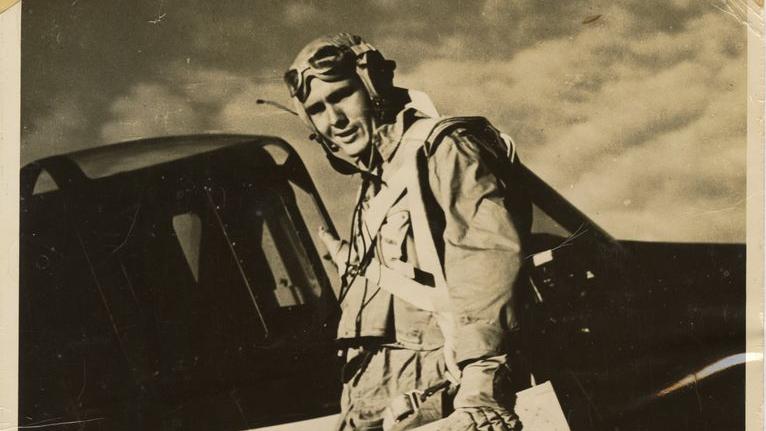
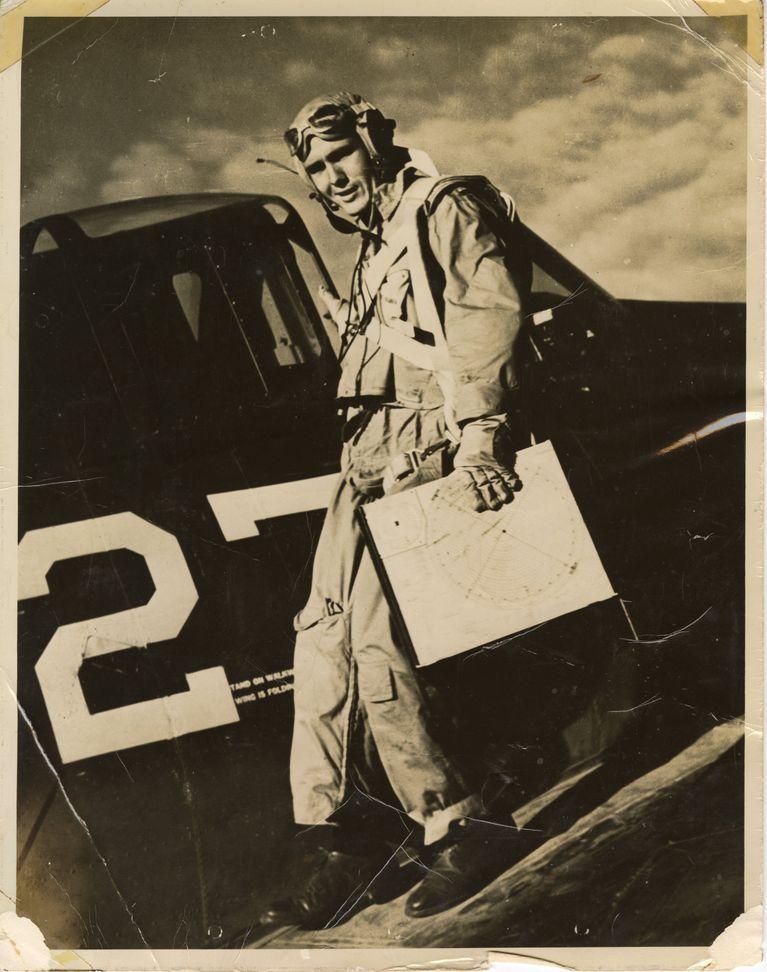
During those first few months aboard the Yorktown, Smokey excelled in his new role and by the time the Yorktown reached Hawaii in July of 1943, Smokey had established himself as an important part of the ship’s combat information center (CIC). However, he quickly realized that what he really wanted to do was fly. Smokey’s experience as a veteran flyer served the CIC well as he worked to help coordinate the ship’s aircraft movements and relay information to the ship’s anti-aircraft guns. While working in this area Smokey was also petitioning the ship’s captain, Joseph “Jocko” Clark, for permission to return to active combat. Smokey believed that he was most useful in the cockpit, even if it put him in a more dangerous position.
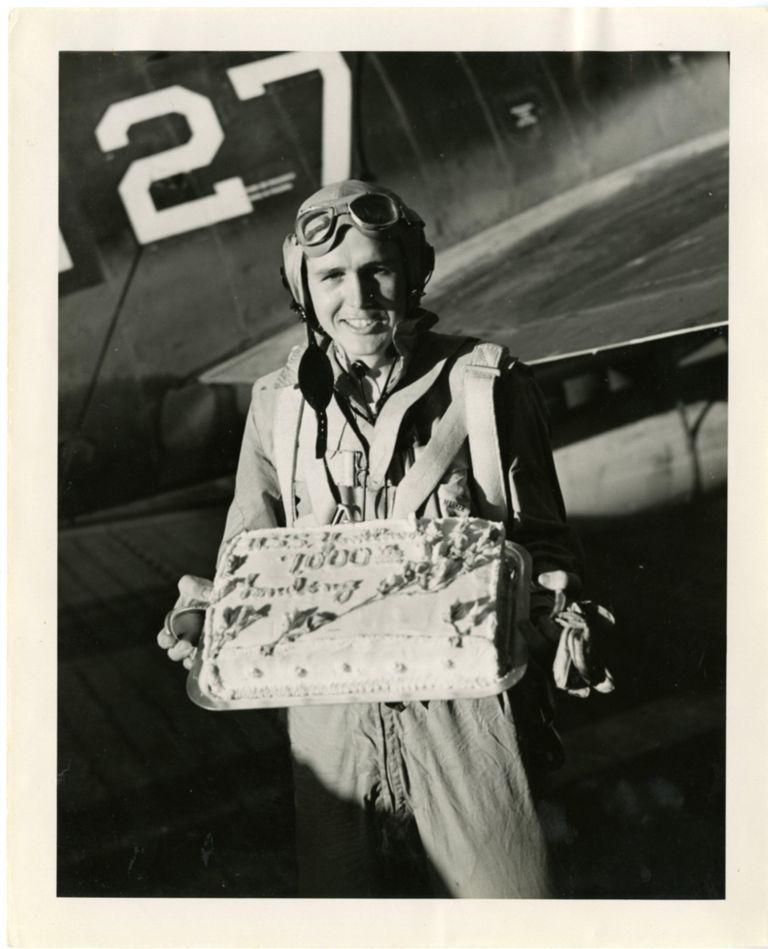
Photograph of Elijah "Smokey" Stover standing on the flightdeck of The USS Yorktown (CV-10). Smokey is holding a cake congratulating him for making the 7,000th landing on the Yorktown.
Smokey would finally get his opportunity to return to flying in December of 1943. The Yorktown had just returned to Pearl Harbor for a brief rest, and the Navy was taking the opportunity to shift personnel as needed. Fighter pilot Melvin “Boogie” Hoffman was transferred off the Yorktown in order to lead his own squadron. Smokey Stover would use this opportunity to rejoin Fighting Five’s combat pilots. Finally, Captain Clark agreed, and Smokey rejoined Fighting Squadron Five as the leader of his own division within the squadron. After a few engagements that saw limited resistance, the Yorktown and the newly formed Task Force 58 set its sights on a new target: Truk.
Truk Atoll (now Chuuk Lagoon) was a Japanese anchorage and the first real challenge the Yorktown had faced since leaving Hawaii. While over Truk, Smokey’s plane would take a direct hit to its engine. Smokey would attempt to gain altitude, but he was eventually forced to bail out only a few miles away from the island. He successfully bailed and deployed his life raft; he climbed aboard and awaited rescue while giving a thumbs up signal to his squadmate Den Merrill who circled overhead. Several attempts were made to coordinate rescue efforts towards Smokey’s location, but none were able to arrive before Merrill was forced to return to the Yorktown or risk running out of fuel. That was the last time that anyone in Fighting Squadron Five saw Elisha “Smokey” Stover.
None of the men who served alongside Smokey would ever forget him. On January 26, 1957, while the Yorktown was still in service, the Yorktown Association dedicated a plaque in his honor aboard the ship. As the plaque states, Smokey Stover represents so many Americans who chose to go into battle knowing the risks and did not return. One of the driving forces behind the movement to establish the Yorktown as a museum ship was to create a place to remember those that did not return. Jim Bryan touched on this feeling in a letter to Smokey’s parents only a year after the war ended. “I am able to buy pictures and models of the Yorktown to have around home to look at and admire, but there is no opportunity to get a picture of the fellow who goes hand in hand with it.”
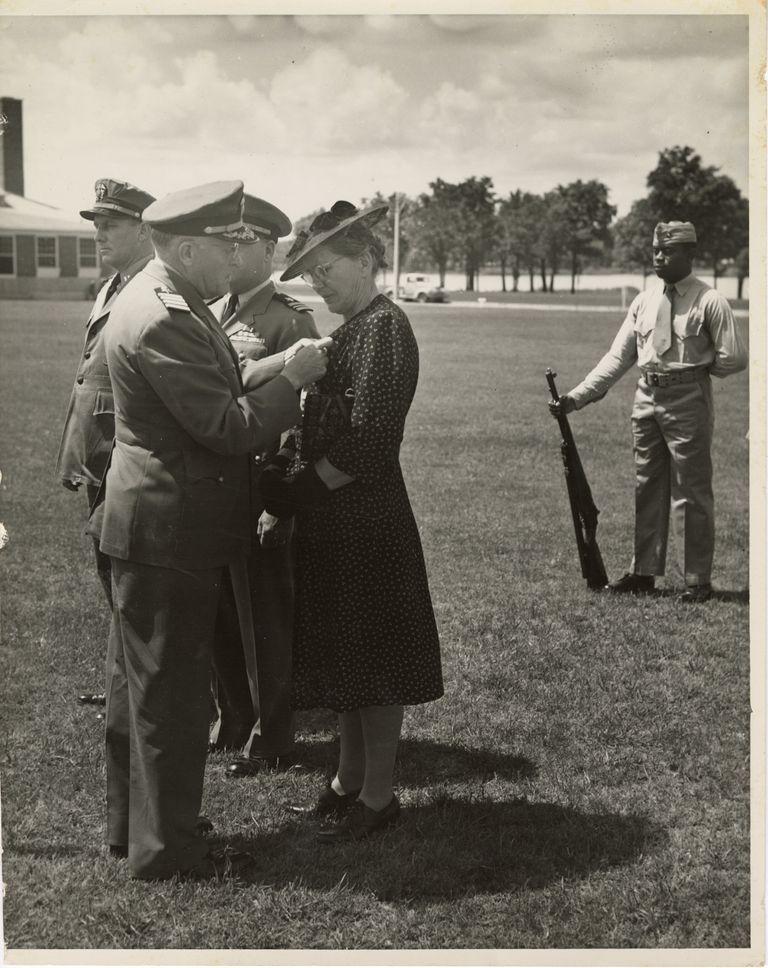
Stella Stover, the mother of Smokey Stover, stands ready to receive an American military award. The medal, though unidentified, was most likely Smokey Stover’s gold star, presented in lieu of a second Air Medal. It was awarded to him posthumously in 1952.
The Fighting Lady is an impressive ship, but her crew is what made her extraordinary. Today, Smokey Stover’s story endures not just in plaques or records, but in the living legacy of the ship he helped define. His memory is honored aboard the USS Yorktown in a powerful and permanent way—the ship’s theater now bears his name, ensuring every visitor encounters the story of his courage and sacrifice. The Fighting Lady stands as a monument to his bravery and to the countless sailors and aviators whose devotion carried her through the darkest days in history. Though his absence is still felt, Smokey’s spirit remains woven into the steel of the Yorktown, reminding us that it was her people who gave this ship its heart.